Wednesday, October 21, 2009

How to Install OSSIM

OSSIM stands for Open Source Security Information Management. Its goal is to provide a comprehensive compilation of tools which, when working together, grant network/security administrators with a detailed view over each and every aspect of his or her networks, hosts, physical access devices, server, etc.

1.- Download OSSIM Download from home page.
2.- Create a new VMware.
3.- Boot from the CD-ROM


OSSIM User Guide

Sunday, October 18, 2009

WinSCP

WinSCP connecting the IpCop

The following five steps are optional only if you are going to use the IpCop keyboard and monitor

• Download WinSCP
• Enable the ssh on the IpCop box
• Reboot the IpCop box
• Connect to the IpCop with WinSCP (port is 222)
either if the port is the same 222 you can connect simultaneously the WinSCP and putty
• Connect to the IpCop console with putty (port is 222

Monday, October 5, 2009

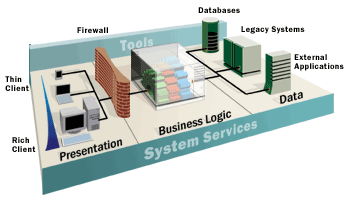
Programming Layers


(http://www.docirs.cl/arquitectura_tres_capas.htm)

The layered programming is a programming style in which the primary objective is the separation of business logic from the logic design, a basic example of this is to separate the data layer from the presentation layer to the user.

DAL: A Data Access Layer is a layer of a computer program which provides simplified access to data stored in persistent storage of some kind, such as an entity-relational databse.

This data access layer is used in turn by other program modules to access and manipulate the data within the data store without having to deal with the complexities inherent in this access.


BL: Business logic is a non-technical term generally used to describe the functional algorithms that handle information exchange between a database and a user interface. It is distinguished from input/output data validation and product logic.

Presentation Layer: it is seen by the user (also called the "user layer"), introduced the system to the user, communicates to capture information and user information in a minimum of process (perform a filtering Prior to check for any formatting errors). This layer communicates only with the business layer. It is also known as graphical interface and must have the characteristic of being "friendly" (understandable and easy to use) for the user.

Sunday, September 20, 2009

IPCop plus URLFilter

Here you got another video tutorial about installing urlfilter in IPCop

Firts you have to download WINSCP from the source page http://winscp.net/eng/download.php#download2 and install it on you windows xp

Then download URLfiltre

And now just follow the video.

Tuesday, September 15, 2009

Installing IPCOP

IPCOP
Its sole purpose in life is to protect the network that it is installed on. By implementing existing technology, outstanding new technology and secure programming practices, IPCop is the Linux Distribution for those wanting to keep their computers/networks safe and sound.

here you got a video about installing ipcop on VNWARE


doubts?
http://www.ipcop.org/1.4.0/en/install/html/

Tuesday, September 8, 2009

Basic Concepts

Lambda
A lambda expression is an anonymous function that can contain expressions and statements, and can be used to create delegates or expression tree types.

Polymorphism

The term polymorphism refers to the ability of two or more objects beloging to different classes to respond exactly the same message (method call) in different class-specific ways.

The term polymorphism is defined in Merriam Webster's Disctionary as:

"The quality or state of being able to assume different forms"

Abstraction:

A process that involves recognizing and focusing on the important characteristics of a situation or object, and filtering out or ignoring all of the unessential details.

Object:
Is a software construct that bundles together data(state) and functions (behavior) which, taken together, represent an abstraction of the real world (physical or conceptual) object.

Attributes:
this is the data that characterizes an object. These are variables which store data relating to the state of an object.

Methods:
An object's methods characterize its behaviour, meaning all actions that the object itself is capable of performing. These operations enable the object to respond to external requests. Furthermore, operations are closely linked to attributes, as their actions may depend on or even modify attribute values.

Classes:
Is an abstraction describing the common features of all members in a group of similar objects.

Instantiation:
Is used to refer to the process by which an object is created/constructed based upon a class definition.

Encapsulation:
Is a formal term referring to the mechanism that bundles together the state information(Attributes) of an object into a single logical unit.

Delegation:
If a request is made of an object A and, in fulfilling the request, A in turn requests assistance from another object B, this is known as delegation by A to B.